Stablecoin Growth Stalls Despite Fidelity Launch & AWS Payment Push


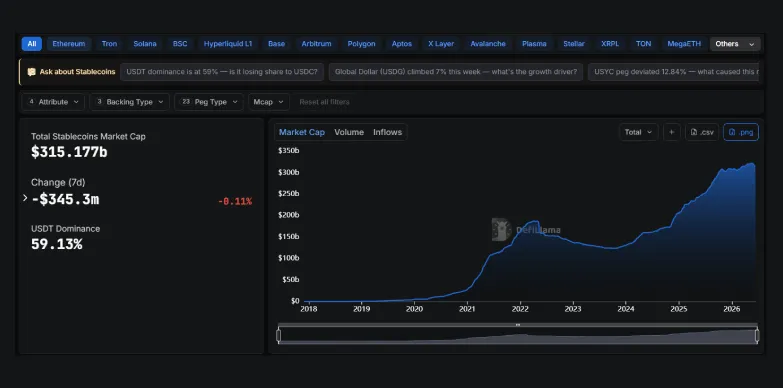
Stablecoin market cap has slipped from $323 billion in May 2026 to $315 in June 2026. This drop was highlighted by crypto influencer Leon Waidmann on the social media platform X today, June 18, 2026. According to the post, the influencer stated that this has been the first notable stall in months for coins designed to hold steady value. The pullback has traders asking a clear question: if more companies and institutions are supporting stablecoins, why is the market not expanding?
What Happened to the Market Cap?
After a long run of steady inflows, total stablecoin supply dropped to about $315 billion in June, down from roughly $323 billion in May as per DeFiLlama. Even though this is a small drop, it is equally impactful and signals that investors are rebalancing portfolios, taking profits or moving into other asset classes. It also comes as several big institutional moves are pushing the narrative that stablecoins are becoming mainstream.
Big Moves on the Infrastructure Front
The market is not starved of headlines. Fidelity recently launched the Fidelity Reserves Digital Fund to manage stablecoin reserves for issuers and institutional clients under the GENIUS Act framework. This product is designed to give issuers a professional custody and yield management option, which should make issuing and holding stablecoins more appealing to conservative players.
Meanwhile, cloud and blockchain integration are accelerating. Amazon Web Services now supports stablecoin payments on Solana for AI traffic monetization, letting CloudFront publishers charge bots in $USDC per request. These kinds of technical wins point to real use cases beyond trading, especially as AI workloads grow.
Why Headlines and Supply Do Not Match Up
There are several reasons that explain why new products and integrations are not immediately swelling stablecoin supply.
- Cashing out and profit-taking: Traders who rode rallies may be converting stablecoins back into fiat or into other risk-on assets such as equities or crypto tokens, lowering circulating supply.
- Regulatory caution and compliance delays: Even with cleaner frameworks emerging, many banks and custodians remain cautious. This slows issuer onboarding and prevents rapid scale among institutional users.
- Yield competition: DeFi and money market yields on stablecoins have compressed as liquidity shifts. If returns fall, big holders prefer other yield-bearing instruments or short-term treasuries.
- Market rotation into AI and stocks: Short-term capital is chasing the AI narrative and other high-growth sectors, even pouring into big private equity moves. So basically, investors are reallocating into high-profile raises or secondaries like SpaceX, which pulls cash away from fresh stablecoin minting.
- On-chain use cases lag: Integrations are growing, but real-world payment volume and continuous programmatic demand are still nascent. One-off integrations do not immediately translate into persistent minting.
- CLARITY Act Shifts Demand: The CLARITY Act also cooled stablecoin demand. While it allows rewards from staking and liquidity programs, it blocks passive interest on payment stablecoins. This move might also have pushed some investors toward money market funds and short-term Treasuries for steady returns. With the bill still awaiting final approval, many investors also reshuffled their portfolios, likely contributing to the $8 billion drop in stablecoin supply from May to June.
What Could Flip the Trend Back Up?
Stablecoins still have a clear runway if a few conditions materialize. Wider banking integrations and clearer compliance paths would let larger institutions park reserves in stablecoins with confidence. Attractive, secure yield products for institutional stablecoin balances could stem outflows. And genuine merchant payments or machines-to-machine microbilling, the AWS-Solana use case for AI traffic, for example, could create steady demand rather than episodic spikes.
Investor sentiment will also matter. If crypto markets calm and investors return to seeing stablecoins as a defensive or liquidity tool, the circulating supply could recover quickly.
Why This Matters
A pause in market cap growth does not mean the stablecoin story is over. However, it highlights that there is some kind of transition taking place, where the plumbing and institutional products are improving, but regulatory, yield, and usage frictions still limit explosive growth.
The crypto community should look out for sustained on-chain volume, steady inflows from institutional custody products, and merchant adoption metrics.
Final Thoughts
The stablecoin universe is expanding in capability and credibility, with major firms building products and cloud providers enabling payments. Yet supply dipped in June because capital is rotating elsewhere and practical adoption lags behind the headlines.
If issuers, custodians, and merchants close the remaining gaps, the next leg of stablecoin growth could arrive, but for now, the market is catching its breath.