



Bitcoin Fund Flow Ratio Hits Historic Lows: Reversal Ahead?


According to on-chain data, Binance’s share of Bitcoin transactions has come down to 0.010-0.012 of all Bitcoin transactions on the network. It is the sixth time this compression has happened since 2018. The ratio itself is the volume of Bitcoin that enters and exits the exchange divided by the total volume of BTC that moves on the entire blockchain. A historic low value in Bitcoin’s fund flow ratio served as a reliable signal of major turning points in price.
Bitcoin Fund Flow Ratio Near Historic Bottom Zone Again
The fund flow ratio serves as an indicator of the platform’s portion of total trading volume and can reveal periods of centralized platform activity versus the more widespread wallet-to-wallet or custodial transactions.
Higher ratio values typically correspond to periods of elevated exchange participation, where users route more coins for trading, hedging, or rebalancing. In contrast, subdued readings reflect a relative decline in exchange-centric transfers, suggesting that a greater volume of activity unfolds through direct on-chain channels, such as personal wallets or non-custodial services.
This can happen in times of low short-term trading activity or when investors have more consistent long-term positions that are held outside trading platforms.
Historically, this low range has often coincided with a major change in market momentum. Following a significant decline in 2018, this metric settled near the bottom range while the Bitcoin price wavered at lower levels.
Exchange-related movements accounted for a smaller slice of total blockchain traffic, coinciding with a slowdown in aggressive distribution from prior sellers. Wallet data from that era showed increasing stabilization, with coins moving less frequently through centralized venues.
The same trend was observed during the accumulation phase in 2020 before a significant price rally. Prices continued to make multi-month bases with this compressed ratio. While the network-wide transfers remained near normal levels, the chart below highlights that Binance’s share remained capped until momentum picked up and participants reengaged with exchange channels for greater positioning and execution requirements.
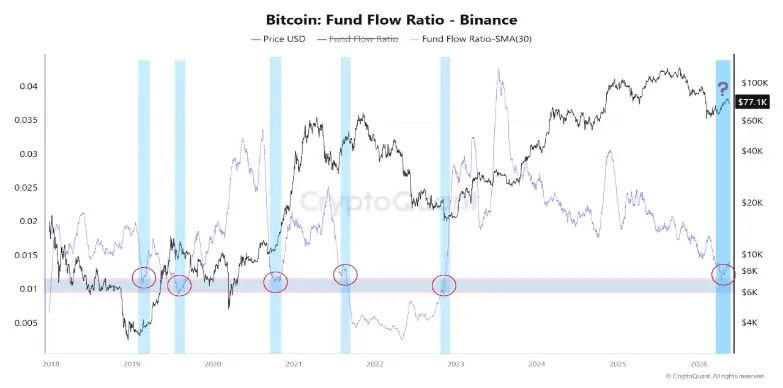
Now the ratio has come back to these familiar waters amid the broader market uncertainty. The blockchain log continues to show typical types of transactions, such as shipping to long-term storage addresses, as well as communication between diverse groups of participants, but the block exchange element is at the bottom of the range seen during previous cycles.
Once demand returned and price momentum accelerated, the Fund Flow Ratio expanded sharply — confirming that investors were actively returning to exchanges to reposition, trade, and chase the emerging trend.
Bitcoin is finally at a pivotal moment, with either low demand or apathy reinforcing the current compression or sell exhaustion, preparing for the next recovery.
Bitcoin Price Faces Breakdown Below Key Support
The Bitcoin price dropped over 2.2% during Friday market hours to reach its current trading value of $75,749. The selling pressure can be linked to macroeconomic conditions as the 30-year U.S. Treasury yield spiked to 5.12%, its highest level since 2007.
These higher yields strengthen the U.S. dollar and diminish investor appetite for high-risk assets like cryptocurrency. Interestingly, the current pullback in Bitcoin price shows a fresh bearish reversal within the formation of a rising channel pattern.
Since early February, the coin price has witnessed a slow yet steady recovery within the pattern’s two parallel trendlines. With today’s drop, the Bitcoin price is challenging the immediate support of $75,500 levels, which also coincides closely with the 20-day exponential moving average.
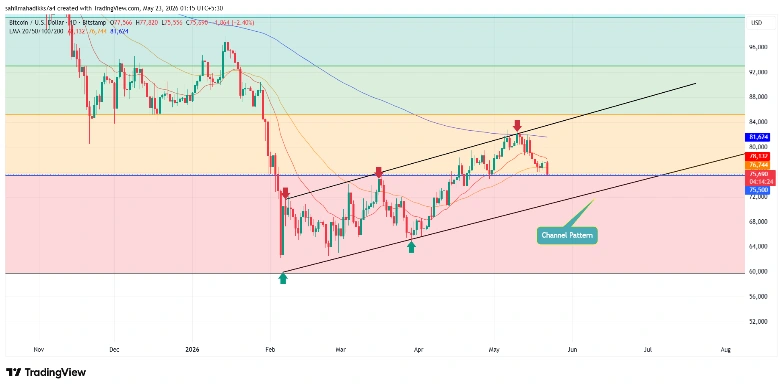
A potential breakdown below this floor will accelerate the market selling pressure and potentially push BTC to the channel’s bottom trendline at $73,500. Until this ascending support trendline is intact, the Bitcoin price continues this mid-term recovery.
