



Solana Price Eyes $68 as Inverted Flag Breakdown Looms

Solana, the seventh largest cryptocurrency by market capitalization, showed a slight downtick of 0.75% on Tuesday to currently trade at $84.76. This pullback follows Bitcoin’s momentum as its price dips below the $76,000 floor amid geopolitical uncertainty. However, Solana is witnessing a significant surge in speculative demand as perpetual trading volumes are soaring to new highs. Will the heightened leverage trading drive price increases in the spot market?
Solana Perpetual DEX Volume Reaches New Highs
Perpetual futures trading on Solana reached new all-time highs last week, with decentralized exchanges handling more than $20 billion in total volume. On May 18 alone, daily activity climbed to $5.781 billion, driven heavily by GMTrade, which handled roughly $4.9 billion in 24-hour volume.
The open interest was at $415.49 million during this period, with a significant increase in volume bars in blue. The 30-day perpetual volume has now surpassed $49.79 billion, with weekly figures up more than 83%.
Meanwhile, a large public wagering-style transaction occurred on the Phoenix protocol, adding to the buzz surrounding Solana derivatives. This featured the participation of Vibhu, Chief Product Officer of Solana Foundation, as well as renowned Hyperliquid trader Drews888, reflecting the increasing interest in high-stakes trades in the Solana ecosystem.
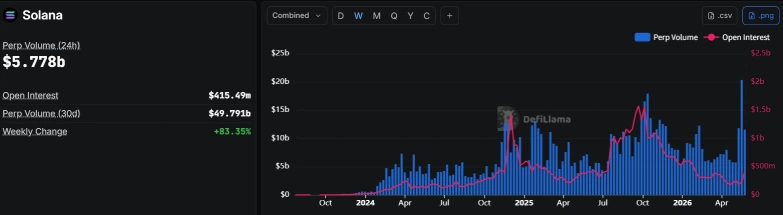
The rally is driven by continued growth in Solana’s perp trading ecosystem, as well as the overall market activity.
While momentum in strong derivatives may drive up prices in the future, it is likely to be contingent on the broader sentiment in the crypto market and on continued capital inflows.
Pump.fun Adds USDC as Base Asset Option for Token Graduations
Pump.fun is updating a core mechanic of its memecoin launchpad starting May 21. Creators will now choose between SOL and USDC as the base asset when their token graduates from a bonding curve to a PumpSwap liquidity pair.
Until now, every graduation automatically created a SOL-paired pool, making Pump.fun a consistent driver of SOL liquidity demand. This automatic connection now fails. With the launch of USDC pairs, additional volume and liquidity that was previously directed to SOL trading may now end up in stablecoin.
The appeal to creators is clear: projects can now provide stable-denomination liquidity from inception, making it more appealing to participants who prefer not to worry about the price fluctuations of SOL.
The update comes with a stealth risk for Solana’s SOL coin. Pump.fun has been a very consistent organic source of SOL demand on the network. Participants have always held and deployed SOL in every launch and every graduation historically. USDC pairs remove that requirement.
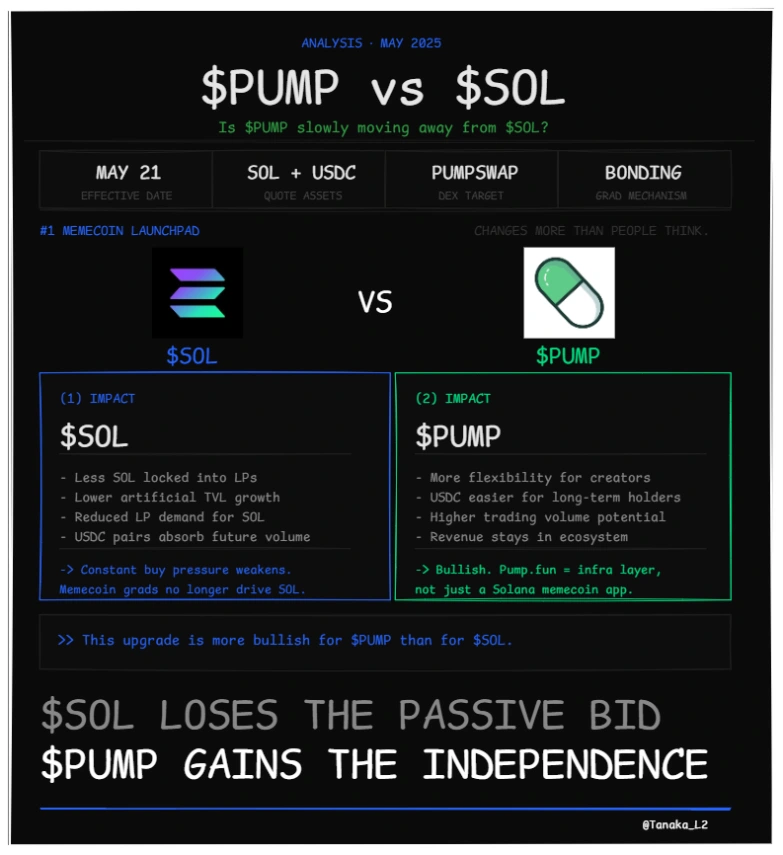
As stablecoin pools become more popular, the correlation between meme-coin trading volume and SOL buying pressure diminishes; less SOL locked up means fewer forced buy orders, lower velocity of native tokens. That’s a structural demand leak to watch for a network that’s heavily reliant on Pump.fun’s activity to drive its on-chain metrics.
Solana Price Faces a Major Breakdown From Bear Flag
Solana price dropped today and it challenges the key support trendline of an inverted flag pattern at $84.15 in the daily chart. Theoretically, the chart setup is characterized by a long down sloping trendline, denoting the aggressive bearish trend in price, followed by two parallel or converging trendlines that allow sellers to regain prevailing momentum.
Following the potential impact of Pump.fun’s USDC integration on SOL demand, the rise of leverage trading mentioned above creates an additional downside risk for the Solana price, as excessive long-positioned amid weakening on-chain activity could trigger sharp liquidation.
Thus, a potential breakdown below the pattern’s support trendline could intensify market selling pressure and send Solana’s price to $68 support.
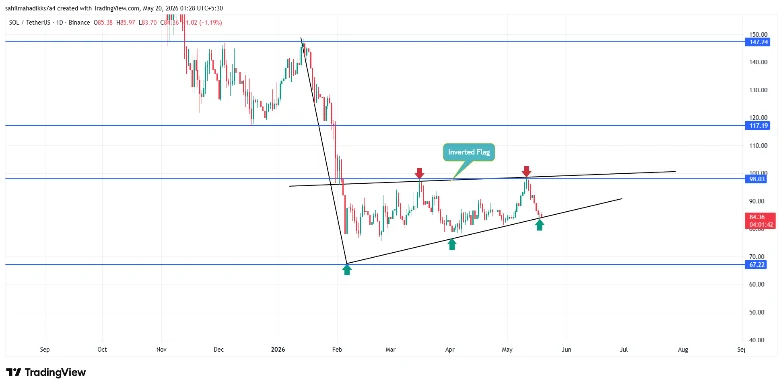
On the contrary, if buyers continue to defend the flag support trendline amid market volatility, Solana price could rebound for a possible upside breakout from the overhead trendline, potentially invalidating the bearish thesis.
